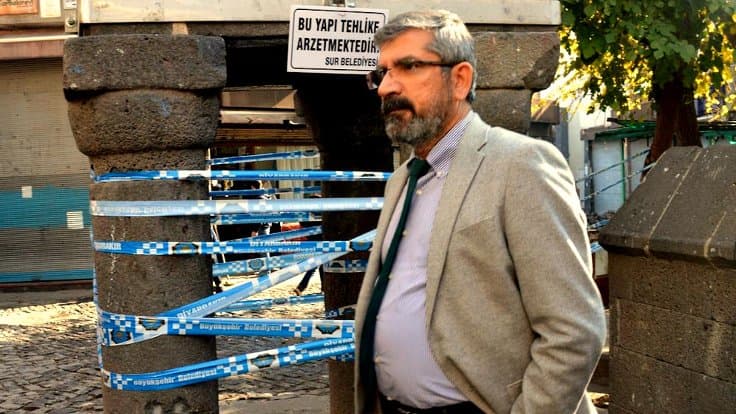
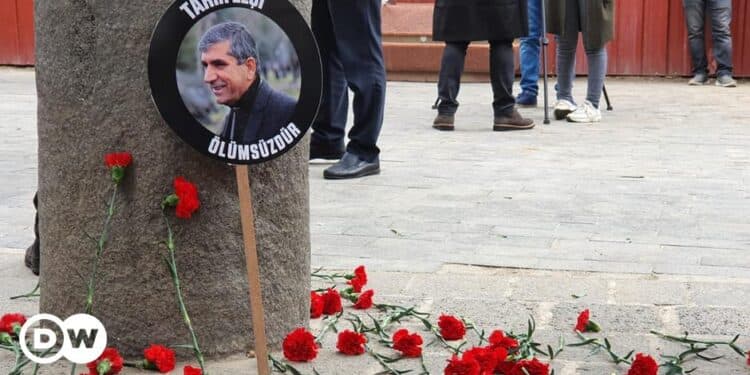
Elçi, the former head of the Diyarbakır Bar Association, was shot in the head during a press conference on November 28, 2015 while calling for peace in front of the historic Four-Legged Minaret. A clash between Turkish police and members of the outlawed Kurdistan Workers’ Party (PKK) erupted at the scene, and Elçi was caught in the crossfire.
The Diyarbakır court acquitted police officers Sinan Tabur, Fuat Tan and Mesut Sevgi, who were on trial for “causing death by gross negligence.” The officers attended the trial via video link and pleaded not guilty. The court’s decision followed a 30-minute recess during which tensions in the courtroom rose.
Before the verdict was announced, Diyarbakır Bar Association President Nahit Eren and Tahir Elçi Foundation President Masum Batı left the courtroom in protest, stating they did not expect a fair decision. They were joined by other lawyers who then marched to the scene of Elçi’s death, the Four-Legged Minaret, to continue their protest.
In the lead-up to the trial, the prosecutor’s office had presented an opinion on April 25, stating that “Elçi was killed by a bullet whose origin could not be definitively determined.” They recommended the acquittal of the three police officers and the conviction of fugitive PKK member Uğur Yakışır for “killing two police officers” and “undermining the unity of the state.”
Lawyers for the Elçi family criticized the handling of the case, stating that their requests to uncover the truth were dismissed. They alleged that evidence was mishandled and destroyed. Türkan Elçi, the widow of Tahir Elçi, noted that the bullet that killed her husband was never found and that “key pieces of evidence, including 40 bullet casings, were lost or destroyed.”
Erinç Sağkan, president of the Union of Turkish Bar Associations, condemned the trial for violating legal principles. “You claim to uphold universal legal principles, but where do we place the principle of direct confrontation?” Sağkan asked. “We were denied the right to cross-examine the suspects, and many fundamental rights of a fair trial were violated.”