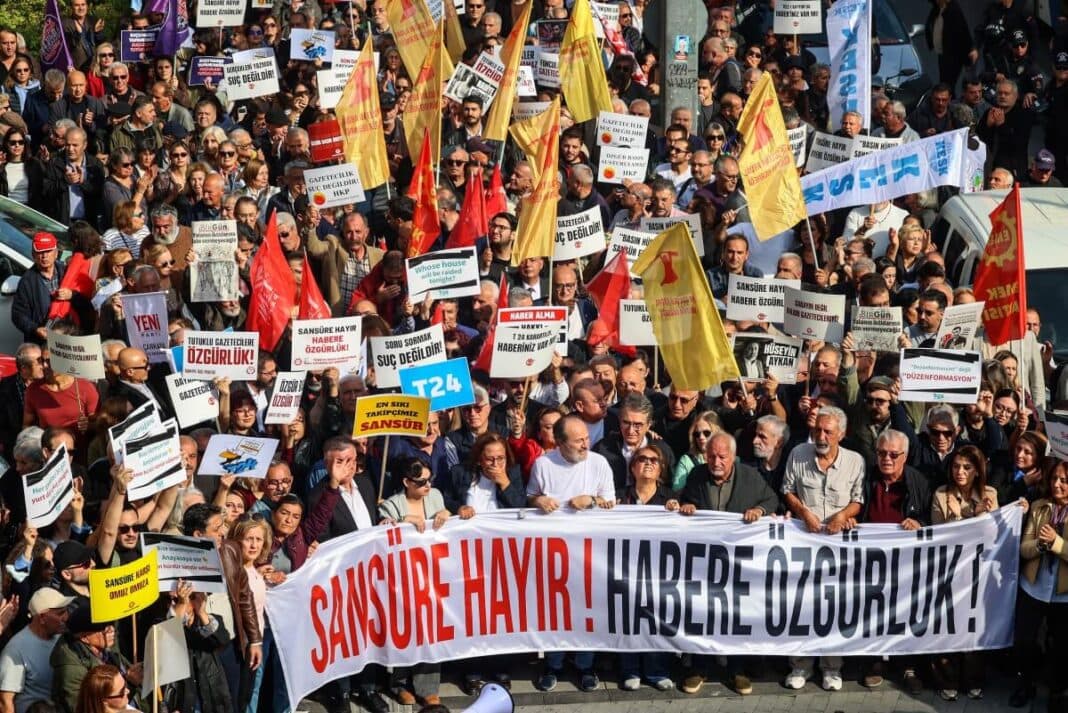
Thousands rallied in İstanbul and Ankara on Saturday against what they described as growing pressure on journalists in Turkey, including arrests, media shutdowns and the appointment of government administrators to run news outlets.
Press freedom has been increasingly constrained in Turkey since a failed coup attempt in 2016, with sweeping prosecutions, digital censorship and government accusations that journalists are spreading fake news.
“Enough!” shouted marchers, mainly journalists, rights activists and opposition party representatives. “We can no longer breathe!”
On İstanbul’s Asian side, protesters held up photos of jailed journalists, chanting: “We will not be silenced. Enough is enough!” and “We will not bow to pressure”.
At least 3,000 people attended each protest, according to police counts.
Recent weeks have seen what rights advocates describe as mounting pressure on independent journalism.
Eleven journalists have been jailed in the past two months and several media outlets shut down, according to the Turkish Journalists’ Union (TGS).
Earlier this month, police raided Turkey’s most-watched news channel, Halk TV, halting broadcasts and installing a government-appointed administrator.
The takeover was the latest move against media outlets seen as critical of President Recep Tayyip Erdoğan and his government.
It followed the blocking of leading digital news outlet T24’s website and social media accounts over what Turkish officials described as “LGBT propaganda”.
‘Intimidation’
“This gathering is not simply about standing up for journalists,” veteran journalist Zafer Arapkirli told Agence France-Presse after the İstanbul protest.
“It is also about defending respect for society’s right to access information and news through journalists and independent media,” said the columnist for the BirGün daily.
Arapkirli, who himself faces lawsuits, said the response and determination to resist must grow as the pressure intensifies.
“What the regime wants is to intimidate, silence and frighten society through such pressure — by arresting individual journalists, seizing media outlets, banning news coverage and blocking access to social media,” he said.