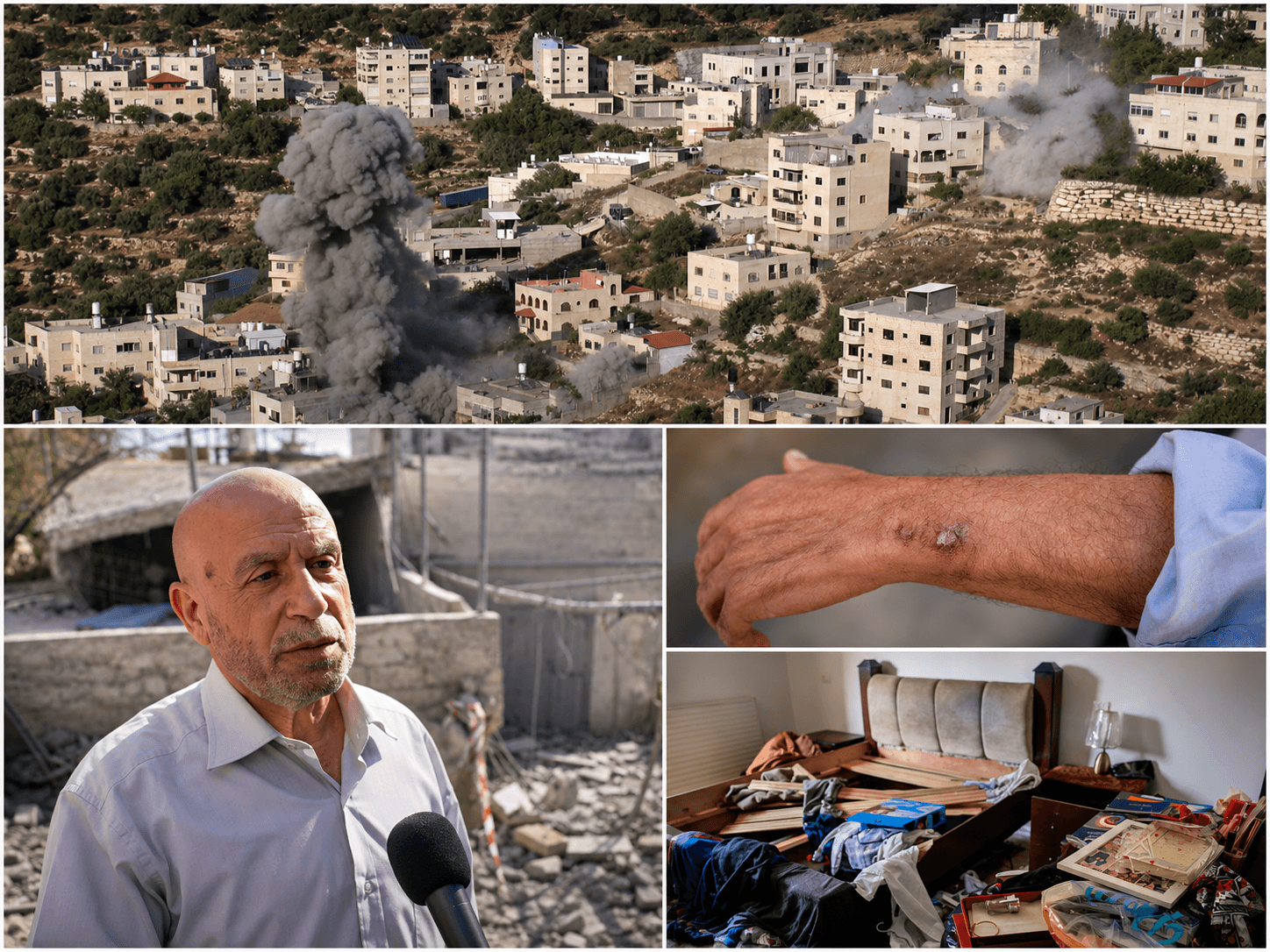
Standing on the rubble of what was once his family’s home, Wael al-Jabaa was stony-faced as he described the events of the past fortnight — and in particular the actions of his son, which prompted the destruction of the property.
Israeli authorities ordered the demolition in Hebron’s west, after 27-year-old Hamouda al-Jabaa and another gunman opened fire on Israeli soldiers at a military checkpoint on October 23.
The men killed two Israeli soldiers and injured others during the 20-minute shootout before they were shot dead.
Mr al-Jabaa said he would have tried to stop his son, had he known what he was planning.
“It was not easy. It was very difficult for us,” he told the ABC.
“I love my son and I don’t hate our son — but sometimes I support him and sometimes I don’t support him.
“An act like this has caused us a lot of losses. We lived a normal life. Now we have losses.”
The demolished house of Palestinian gunman Hamouda al-Jabaa. (ABC News: Hamish Harty)
The shooting triggered an 11-day siege of Hebron, with the Israel Defense Forces (IDF) launching a major military operation in the West Bank’s largest city.
“We will act to destroy this place, to change it completely,” Prime Minister Benjamin Netanyahu said in the hours after the shooting.
The gunmen’s homes were demolished and dozens more buildings destroyed in a show of force from Israeli authorities.
Hundreds of families were also forced from their homes, mostly in the Al-Jalda and Ein Deir Bahha neighbourhoods, as soldiers went from building to building claiming to search for weapons and terrorists.
Wael al-Jabaa was among dozens to be arrested. He was held for 10 days, and had cuts on his wrist from where he said handcuffs were secured too tightly.
He told the ABC he was not allowed access to a toilet for the first three days of his detention.
“I peed on myself when in detention. Why?” he said.
“My son was 27 years old, he was married and had two children — how could I be responsible for his actions?”
Wael al-Jabaa says his wrists were injured from handcuffs. (ABC News: Hamish Harty)
He said he did not support acts of violence against Israeli forces, saying they were not worthwhile given the significant power imbalance.
“You cannot resist them, you can’t use any other means, you have to be silent and co-exist with them,” he said.
The ABC asked the IDF for a response to Mr al-Jabaa’s claims of mistreatment, but its response did not address the allegations.
‘You have five minutes to leave’
Thousands of Palestinians were permitted to return to their homes this week after Israeli forces withdrew, but many returned to properties that had been damaged, vandalised or robbed.
Among them was the Mujahid family, who returned to their flat to find soldiers had ransacked bedrooms and broke furniture.
Abed al-Shakour and his family couldn’t access their home for 10 days. (ABC News: Hamish Harty)
“I was the first house in the whole neighbourhood … that the army entered,” one member of the household, Abed al-Shakur, told the ABC as the family slowly cleaned their home.
“They knocked on the door and entered here without saying much. They said, ‘You have five minutes to leave your house. There is a military operation in the area and you have to leave the house.’
“So we left the house for 10 days. When I came back to my house, as you can see, it was all destroyed.”
Abed al-Shakur said he had to buy new mattresses for his two young sons because the old beds had been drenched in urine.
The bedrooms in Abed al-Shakour’s apartment were trashed. (ABC News: Hamish Harty)
He also said his eight-year-old son, Yamen, had chest pain from the stress of the eviction.
“We took him to the hospital, they did a heart test and did a full examination,” Abed said.
“They examined him and said he was in a psychological shock.”
Neighbours told the ABC many of the flats had been left with rubbish strewn throughout, including used condoms.
Down the street, tenants were returning to a commercial building that had been taken over by Israeli soldiers.
The complex usually houses doctors’ clinics, lawyers and other companies. But during the siege, said one business owner, it became a base for the IDF.
Obaida Mujahid alleged that several cameras had been stolen during the siege. (ABC News: Hamish Harty)
Obaida Mujahid, who owns a camera and production company on the third floor of the building, told the ABC a sniper was stationed on the balcony overlooking the roundabout below.
“[The IDF] destroyed them [homes and businesses]. They had a whole building for them as headquarters to sleep in,” he said.
“They were smoking hookah, it was a mess here.”
Mr Mujahida also said at least 10 of his cameras and 17 camera lenses had been taken by soldiers, along with computer hard drives.