
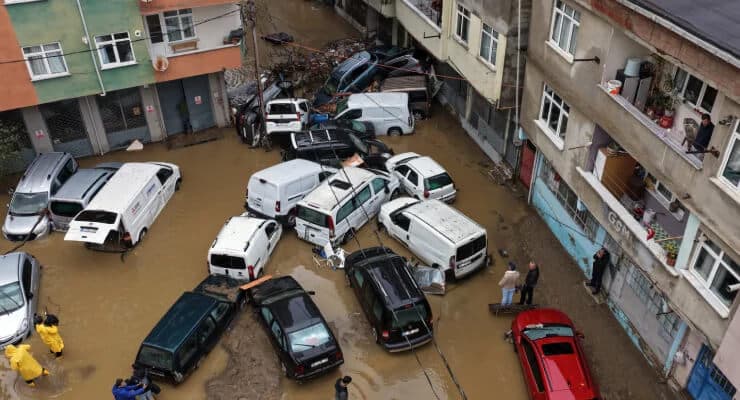
The death toll from severe flooding in İstanbul rose to two on Thursday as emergency crews continued rescue operations, flights were disrupted and school closures were extended through Friday.
Torrential rain submerged roads, swept away cars and flooded homes and businesses across Turkey’s largest city, home to around 16 million people. Governor Davut Gül said crews had rescued more than 2,700 people.
A 34-year-old man died after slipping while trying to cross a flooded street in the northern district of Sarıyer. He struck his head on a curb and was unable to get out of the water. Bystanders pulled him out, but he later died in a hospital, the state-run Anadolu news agency reported.
His death followed the electrocution of a 14-year-old boy Wednesday evening at a park in Balat, a historic neighborhood on the city’s European side. The boy stepped into a pool of water and was taken to a hospital unconscious but could not be saved, the governor’s office said. Investigations were opened into both deaths.
Emergency teams worked through the night to evacuate people from flooded buildings. Rescue operations were continuing at 14 locations Thursday, while three people remained hospitalized with injuries that were not life-threatening, Gül said.
Residents unable to return home were being accommodated in hotels and public facilities.
Rainfall reached 273.1 millimeters — about 10.8 inches — in Beykoz on the Asian side, according to updated municipal figures. That is equivalent to roughly 273 liters of water falling on every square meter of ground. Sarıyer and Eyüpsultan recorded more than 200 millimeters each.
At İstanbul Airport, 51 incoming flights were diverted and 19 arrivals and departures were canceled, Gül said.
Schools will remain closed Friday while teams inspect buildings for electrical faults and other hazards.
Gül urged residents to avoid unnecessary travel, warning that rain was expected to continue for another two to three days and that the ground was already saturated.
Turkey is highly vulnerable to climate hazards because of its geography, population exposure and reliance on sectors such as agriculture, the World Bank says.
Global warming intensifies heavy rainfall, while urban expansion and paved surfaces increase runoff and strain drainage systems, according to the UN’s Intergovernmental Panel on Climate Change.
The flooding comes less than a month before Turkey hosts the COP31 UN climate conference in the Mediterranean city of Antalya from November 9 to 20.https://x.com/AustraliaZaman/status/2110587851167633585